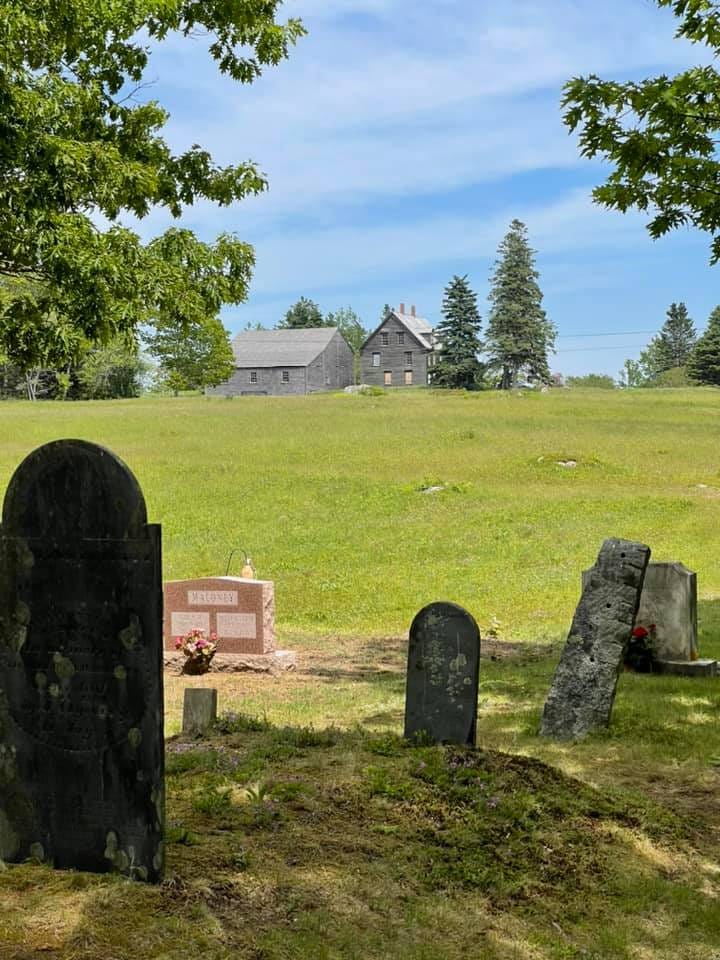
The road to Cushing goes down to the end of a point and there is nothing after it but the sparkling sea.
The dirt road curves and the barn appears first, then the house behind it, three storeys of weathered clapboard on a rise above the fields. Eventually St. George River is visible at the bottom of the slope, the light off the water coming up the hill. I parked and stood to adjust to the air before going in. It was still. The fields between me and the water were olive-colored and the smell coming off them was grass and salt, something faintly marine. The house looked as though it had grown from the hill rather than been built on it.
The front hall floor is painted and stenciled with leaves, the delicate pattern still faintly legible under decades of foot traffic, the paint worn thinnest in the exact center of where shoe and floor met. I imagined Tempus Fugit noticing that, not me, almost like I was borrowing a thought from my character’s head and the purity that autism can bring.
The kitchen is at the rear of the ground floor: the original Glenwood cast iron stove massive and black, a lone egg crock on the shelf, geraniums red in the window. Wyeth painted that stove. He painted the geraniums. He painted Christina sitting at the table that is no longer here, the Glenwood behind her, her life organized around the radius of what she could reach. The pantry behind the kitchen has a metal-lined wood sink box and a water pump and a mechanical roller for wringing out the wash. Beyond the pantry the woodshed, and in the woodshed loft, Alvaro’s dory.
My wandering takes me up a staircase. Into the quiet. Second floor: pale blue painted walls, the wallpaper in the bedroom deteriorating from the top down, the faded pattern breaking apart in strips. The light in these rooms came in at angles that made the plaster look older than it was, or more exactly itself, I still don’t know which.
He came back thirty summers in a row, Andrew did. He said he just couldn’t stay away. Three hundred drawings and paintings came out of this place with its particular quality of Maine light on these fields. The house gave him something he could not exhaust. Imagine that, he found an endless stream of creative water to drink from here. Did he notice things the way Tempus did?
The room on the third floor south side is where he worked for most of those summers, the window here looks down toward the fields and the river. The floor is bare and pale. There is nothing in the room except the window and what it frames. I imagined him standing here, his easel there, wet paint squirming out of a tube to take its first breath in that sea-breeze.
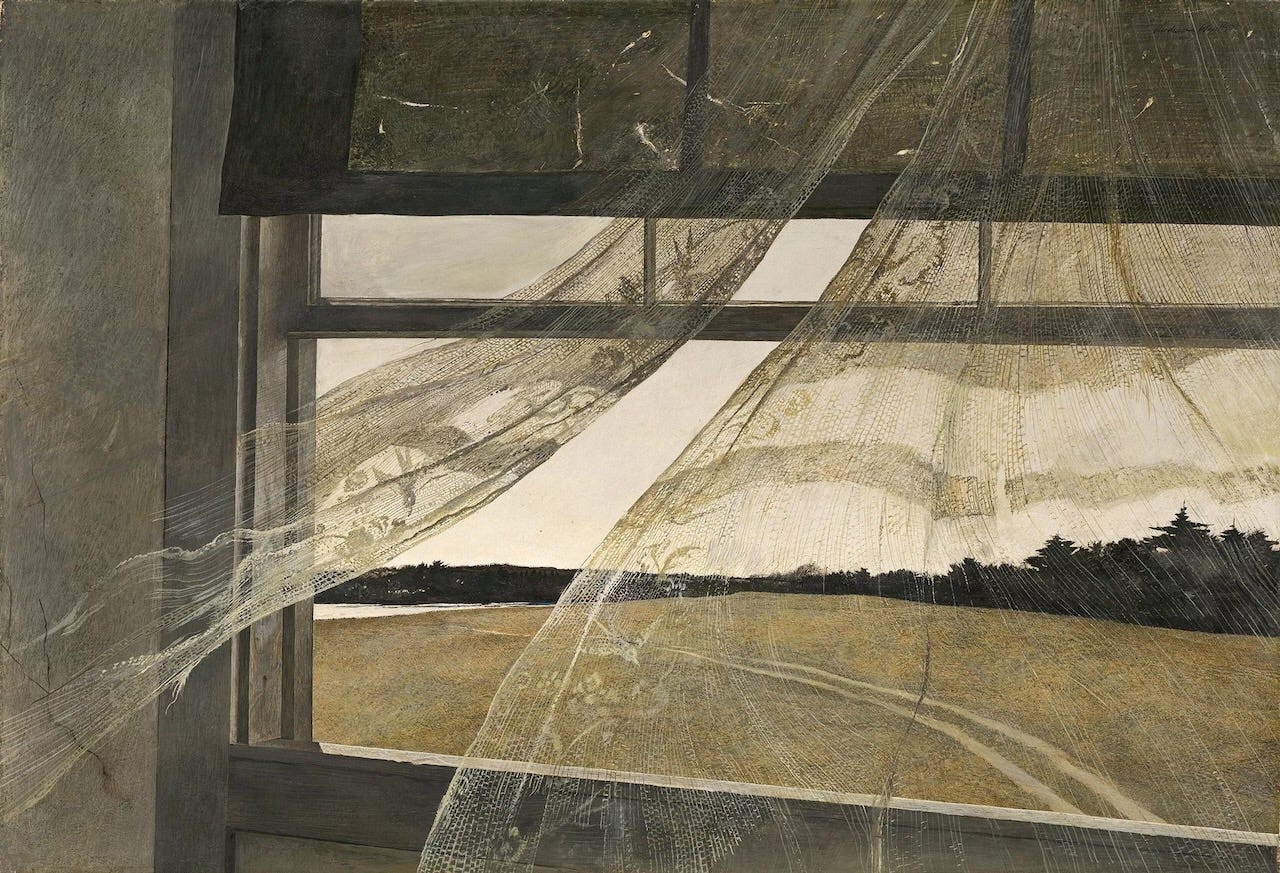
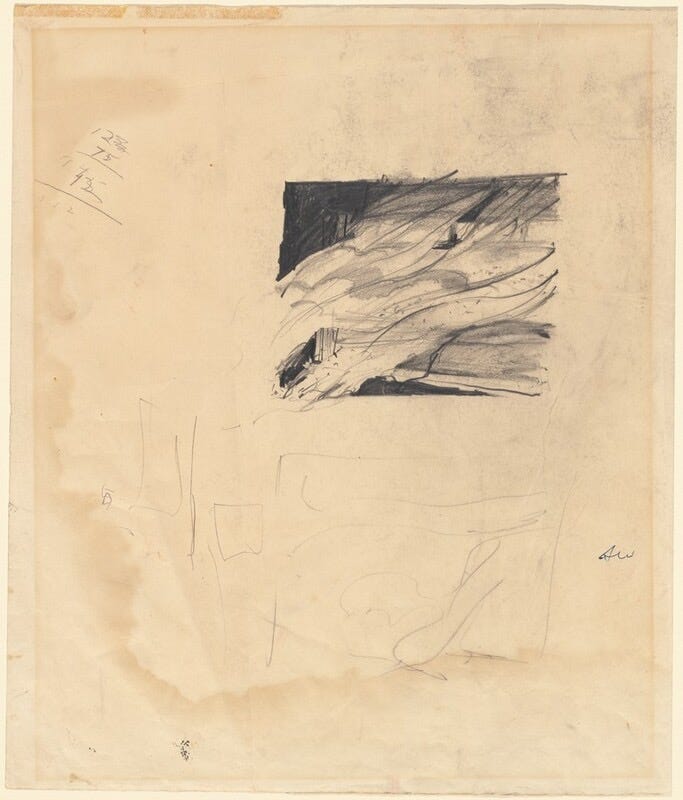
On the other side of the attic, facing west, is the window where Wind from the Sea was born. The curtains are not there. They are in the painting at the National Gallery in Washington and which is what brought me here. There is something about it I cannot put into words. I go to the window, framed by unpainted wood. The view is south over the fields, the same fields, the same line of water at their edge, the same pale sky. He opened this window in 1947, a window that hadn’t been opened in years, and he said the old lace curtains moved in the sea breeze and the crocheted birds along their hems appeared - just for a moment - to be flying. He made a quick sketch and because he described his hair as standing on end. Then he closed the window and waited a month and a half for the west wind to return. Tempus’ story has taken that long, and more.
Outside, the afternoon light was going low across the fields. Before leaving I went down the path across the road to the small family cemetery — barely a dozen stones, the trees opening to a sparkling view of Maple Juice Cove between them. Christina and Alvaro share a stone. A few feet away is his: Andrew Wyeth, 1917–2009. He asked to be buried here; his wife joined him 11 years later in this family’s cemetery. My, how he must have loved them.
Such a desolate place, and yet - I was somehow happy for them.