

I visited Wookey Hole on a Tuesday in November, which is when all sensible people visit things. The coach parties had long packed themselves back into their coaches. The gift shop smelled of fudge and compromise. I had a thermos of Lapsang Souchong, a good scarf, and a determination to look at a witch.
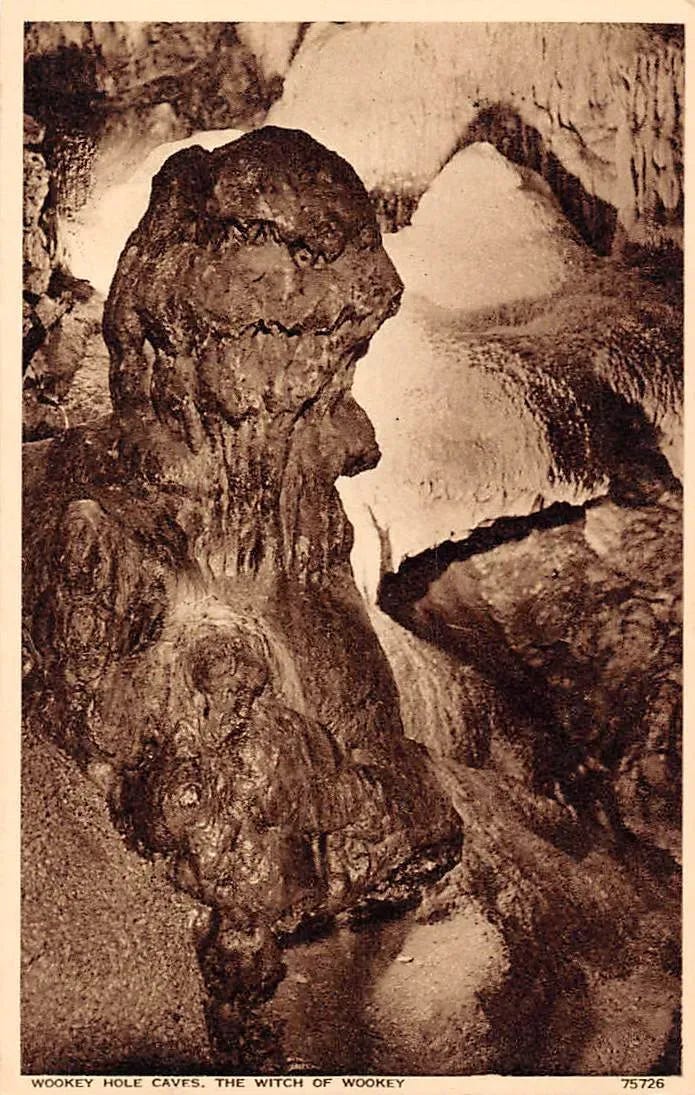
She is not what I expected. I had imagined something theatrical, a pointed silhouette against torchlight, arms raised in permanent hexery. But the Witch of Wookey Hole is a stalagmite. A pillar of calcium carbonate, patient as centuries, shaped loosely into the suggestion of a woman caught mid-turn. Her dog is there too, small and stony at her feet, frozen in the act of following her wherever she was going. Which was deeper. Always deeper.
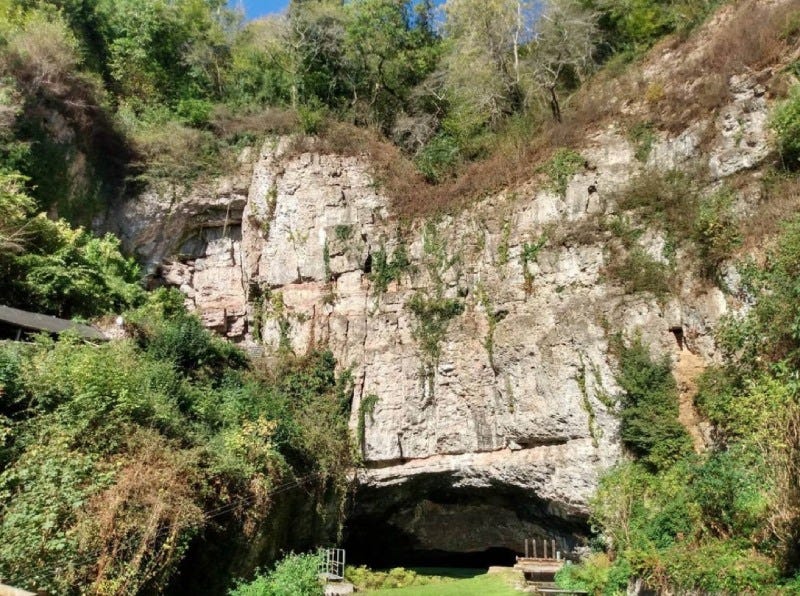
The legend goes like this: with a broken heart, she retreated into the caves. Deeper and deeper, with considerable self-sufficiency, she lived there for years, perhaps decades. The locals grew nervous. They believed she was a malevolent force, blighting crops and cursing the village. But the truth was, she had chosen solitude rather than management, and that sort of choice has always unsettled community. Eventually the problem was handed to a monk. He arrived with holy water and the certainty of a man with a solution. With a splash, she turned to stone where she stood. Facing inward. Looking into the dark.
I poured myself a cup of tea from my thermos. No one was around for a while, it was just me and her. And her dog. Even in stone, she had kept her chosen company. The cave dripped. We didn’t mind. The river ran somewhere below us, getting on with things. It was on my last sip that I felt something clarify inside me. Something the priest didn’t know. She was going the right way.
I am often asked, by people who have misread my author biography as a form of invitation, why I am so private. The answer I give in public is that I find myself tedious company in large doses and consider it a kindness to limit my distribution. This sometimes garners a chuckle, which is its purpose.
The true answer is harder to hold still for examination.
There are people in the world for whom the outside is endlessly manageable. They drive to work and the traffic is simply traffic. They enter parties and the noise is simply noise. They move through the world and the world fits them, not noticing the seam where the wallpaper doesn’t quite meet.
I am not those people. Neither, if you have found your way to these pages, I would wager, are you.
I would like to suggest, gently, that the world has got it backwards.
Wookey Hole smells of ancient water and cold rock and something older than both, time itself, perhaps, settling into limestone at the rate of a millimetre per century. The River Axe runs through the cave system, black and purposeful, going about its business without requiring applause.
I stood in the first chamber for a long time and watched the witch.
There is a particular hum I do when I am thinking through something stubborn. I have written about it elsewhere (see: Why I Hum While I Write, the low bumble-bee frequency that seems to vibrate the good thoughts loose from wherever they’ve gone sticky. I was humming, softly, in the cave. The acoustics were extraordinary. The cold stone hummed back.
What the witch understood, I think, is that going deeper is not running away. It is a form of going toward. Toward the quiet in which something real can finally be heard. Toward the dark in which something real can finally be seen. The outside world had rendered its verdict on her, too much, too strange, too unwilling to arrange herself into a more convenient shape, and she had done the only sensible thing, which was to find a cave, shut the door, and conduct her own investigations.
Privacy keeps me irrelevant. Which is exactly where I should be.
The depth of focus that unsettles people is the same depth that sees what no one else can.
One character I have been writing about, Tempus Fugit, hero of Time’s Last Chance, would love Wookey Hole.
Tempus notices everything, at a depth that exhausts the people around her and sustains her completely. She would study the calcium striations in the witch with the seriousness of a geologist. She would notice the shine on the small stalagmite, the dog at her feet, worn smooth at nose-height by decades of children reaching out. Tempus would see the witch with the tenderness of someone who understands what it means to be looked at wrongly for a very long time.
The witch would have recognized her.
I screwed the cup back onto my thermos, gave the witch a nod, and headed outside where the light hit like an accusation. The fudge shop was closing. I found my battered and beloved car, parked at an odd angle on the verge, evidence that I was thinking too hard about something else.
I started the engine. It complained but in the end agreed, reluctantly, to follow the lane down through the ash trees. Where the hills ran out and the plain began, I stopped at the junction. Looked left. Looked right. Somewhere out on the flat, a hill rose with a tower on top of it, the kind of thing that sits on a horizon as though it has been waiting there specifically for you to notice it on a Tuesday in November with an empty thermos and nowhere particular to be. I turned toward it and drove deeper into Somerset.
Stirrings is where I write about the process of writing, the characters, and the experiences that shaped them. The Underestimated Club is a series of five books that each star a neurodivergent child. If you’ve found your way here, you may be one of those people. Or you may love one. Either way, welcome to the Underestimated Club.