

I only ever arrive here one second after it opens. There is a pocket of time one can have to oneself that begins at 10:00am and doesn’t last terribly long.
I order at the counter and find a table by the fireplace, though it is never lit. Tea in a proper pot, a teacup and saucer, a slice of Victoria sponge on a white plate. I set them down next to my notebook, unwrap my scarf, sit and look up.
The lamps hang from the ceiling like enormous dandelions gone to seed, huge globes, slightly improbable, casting a warmth that has nothing to do with the gray outside.

Columns rise up to support a tiled ceiling ornate and fireproof, the Victorians having decided that beauty and practicality were not mutually exclusive. The walls curve, where stained glass windows carry not saints but instructions: “Hunger is the best sauce.” “A good cup makes all young.” Wrapping all the way around the room are letters that have been there since 1868, saying:
There is nothing better for a man than that he should eat and drink, and make his soul enjoy the good of his labor.
While sitting in this room, I find I have no quarrel with this.
The room has a sound, the clink and settle of cups, the small percussion of spoons, the occasional chair.
I open my notebook. Write a sentence. Look at the tiles. Write another. Look at the stained glass. Something that had been stuck comes unstuck and arrives on the page and I think: yes. There it is.
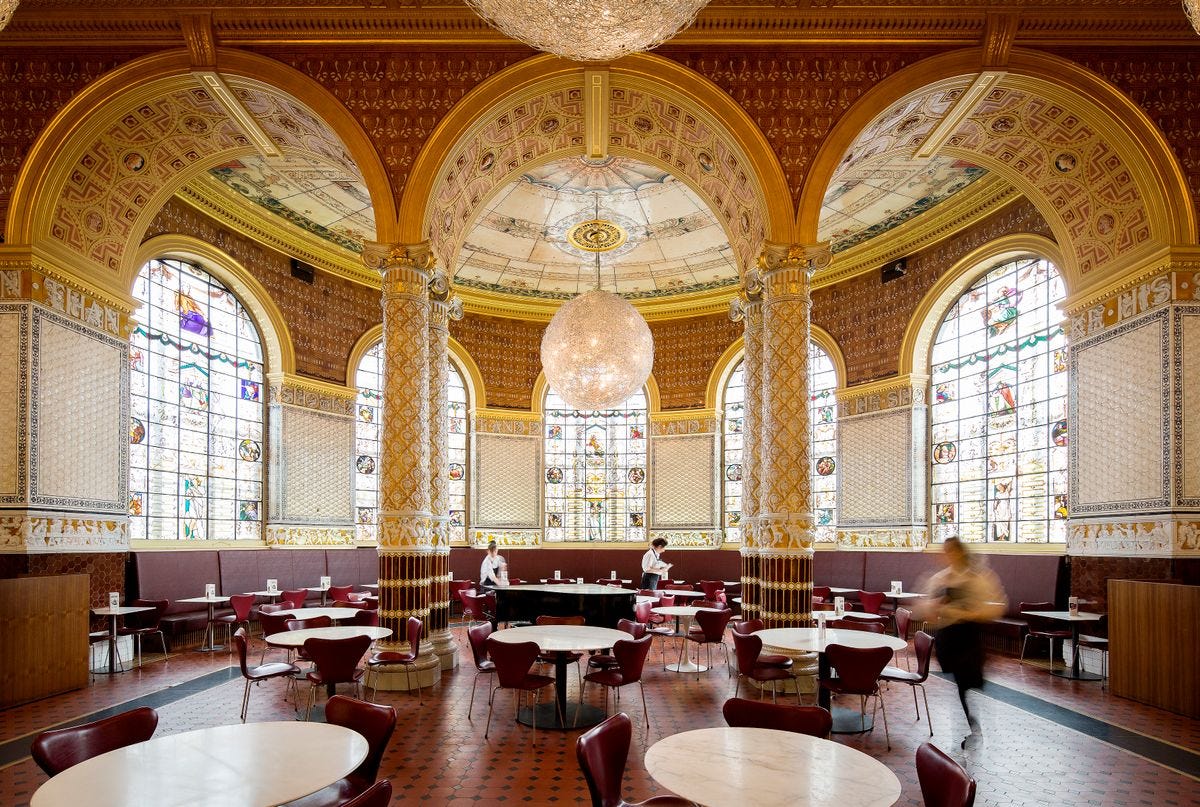
I am, as those who have read anything I have written will know, selective about company. But certain rooms give it, and give it well. Not the company of people, which requires management, but the company of a place that knows you. I have a theory that certain rooms keep a version of you between visits. Not a ghost, nothing so dramatic. Just the particular shape of your attention, held in the walls, waiting. You walk in and step back into yourself. You are, without effort or decision, entirely who you are.
The Gamble Room does this for me. Has done, for years. I don’t fully understand why, and I have learned not to examine it too carefully, in the way one doesn’t examine good luck or a working pen.
I wrote until the tea was cold, and I was, the whole time, entirely happy.
Stirrings is where I write about the process of writing, the characters, and the experiences that shaped them. The Underestimated Club is a series of five books that each star a neurodivergent child. If you’ve found your way here, you may be one of those people. Or you may love one. Either way, welcome to the Underestimated Club.