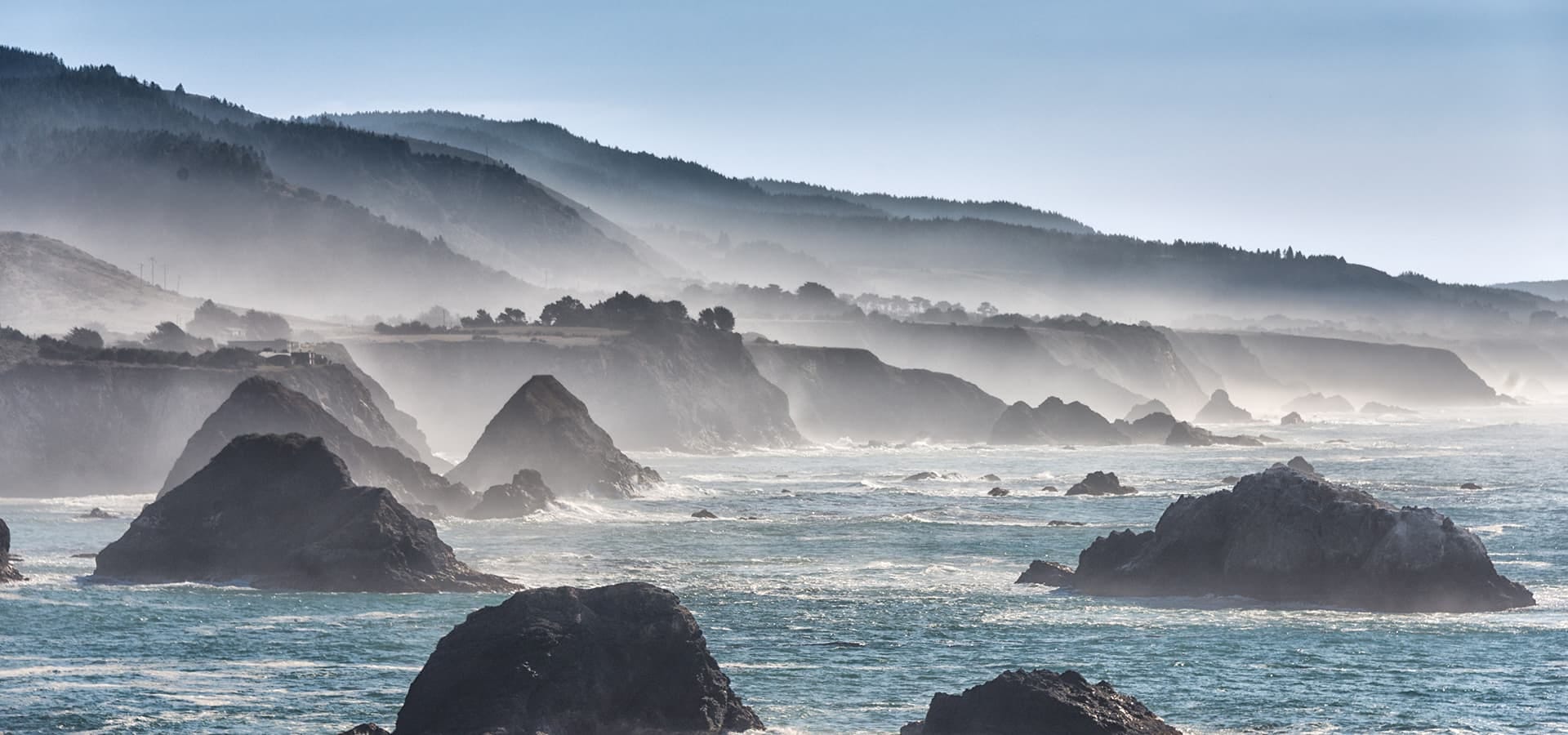
We met on a gray morning at her home in Mendocino. At the bottom of the garden, past the blackberry bramble and the half-collapsed fence, there’s a small writing studio with fog pressing at the windows.
We settled into chairs by the window. Below us, the Pacific was barely visible, more suggestion than certainty. The fog was doing what fog does best—erasing the line between sea and sky.
The room smelled faintly of cedar and black tea. Her orange cat slept through the entire interview.
Q: What is a usual day-in-the-life like for Frumpenella Spoon.
A: Stories hate being the first ones up, so most mornings I come down here before the light decides what kind of day it wants to be,” he said. “The garden’s still wet, and the sentences behave.”
Q: Your books have very particular sensory details. How do you decide what details to include?
A: I don’t decide, exactly. I just notice them when I’m in the scene. If I’m writing about a girl walking up to a house, I have to feel the gravel under my feet, hearing the sound it makes, noticing whether the front door is freshly painted or peeling. Those details arrive when I’m paying attention.
Q: But surely you can’t include every detail you notice.
A: No, you’d drown in them. The book would be unreadable. But I don’t know which ones to keep until later, until I can see what the scene is actually doing.
Q: What do you mean by what it’s doing?
A: Whether it’s about arrival or reluctance or anticipation. If it’s about reluctance, then maybe the peeling paint matters. If it’s about anticipation, maybe it doesn’t. But I can’t make those decisions while I’m writing the scene. I have to just notice everything first.
Q: Why not?
A: Because then I’m not in it anymore. I’m managing it. And when I’m managing, the writing goes dead.
Q: So you write first and cut later.
A: More or less. Though “cut” isn’t quite right. It’s more like... standing back and seeing what’s essential versus what’s just noise.
Q: How do you know the difference?
A: “As one does,” she said, raising an eyebrow.
Q: I’m serious.
A: So am I. It’s hard to explain. Perhaps this is the long way around but around here a house can rise or fall on the window’s promise. Real agents talk about blue water and white water. Blue water is the calm line far out, the band that stays steady. Blue water is the distant view, the horizon, the expanse. White water is the crash on the beach or the spray against the rocks. You can see the surf, the breaking waves, the foam right where the ocean meets the shore. Both are water, yet the experience is different.

And this helps you with details?
A: It helps me understand what I’m doing. When I’m drafting, I need the white water view. I’m right there in the surf zone, noticing everything—the gravel sound, the peeling paint, the way afternoon light hits a windowsill. All the texture and immediacy. That churning tells me who breaks, who holds, who shifts without warning. That’s where the good sentences come from.
Q: And blue water?
A: That’s when I step back. When I look at the whole scene from a distance and ask what it’s actually about. Not what happens, but what it means. Then I can see which details are doing work and which ones are just... there. The white water gives you all the material, all the aliveness. The blue water shows you what the scene can’t live without.
Q: What can’t a scene live without?
A: I had a scene recently—a boy waiting for his father outside a hardware store. In the first draft I described everything. The store window, the smell of sawdust, the way the sidewalk was cracked, the sound of cars passing, the heat of the sun on his neck, a dog tied up nearby. All of it felt important when I was writing it because I could see it so clearly.
Q: But it wasn’t all important?
A: Most of it was clutter. When I stepped back—when I got the blue water view—I could see the scene was really about the boy’s awareness of time passing. So I kept the detail about the sun moving across the sidewalk, the way the shadow of the awning crept toward him. And I cut almost everything else.
Q: That must have been painful.
A: I’ve gotten used to killing my darlings, as the saying goes. All authors are subservient to the work.
A scene that’s been properly shaped, one that knows what it’s about, reads differently than one that hasn’t. Even if you can’t name why. It is the invisible infrastructure that will create the readers’ emotional arc as they embody the characters the readers bring to life.
Q: What about your narrator’s voice?
A: If plot settles in the blue and character stirs in the white, then narration sits between them.
Q: You make it sound like the landscape is a collaborator.
A: An important one. You see that blackberry patch over there. When the wind whips it the bramble shakes as if the branches are sharing gossip. Your writing fingers already know that a white water view narrator would comes in hot. It’s time for detail.
Q: Do you notice the distinction in your finished work?
A: Well, the only important thing is that children don’t. They must be entirely in the scene when they read. The white water is what they should see—the vivid, immediate world of the story. If they see the structure or intention, then those pages should have been another draft, not the final work.
Q: I know our time is coming to a close, but I have to ask you just one more question as I have you here.
A: Ask away.
Q: You’re known as a recluse. In fact, I’ve only been given permission to interview on condition of sworn privacy. Why is that so important to you.
A: Privacy keeps me irrelevant. Which is exactly where I should be.
Outside, the fog was beginning to lift. I left him standing at her window, looking out at an ocean that had finally decided to appear. Along with the outline of a cat who stood, arched her back and walked towards her.