

The light changes somewhere on the stairs. By the time I reached the basement it had turned amber, and I stopped for a moment just to be in it.
A few more steps and I entered a room that is small and low and compressed and absolutely certain of itself. John Soane invented a monk and built him this parlour. But the monk never existed. The grave in the yard outside the window is a fiction. Soane made all of it the year after his wife died. He gave the room another man’s name and then sat in it alone where a stained glass window throws its saints across the wall in reds and blues.
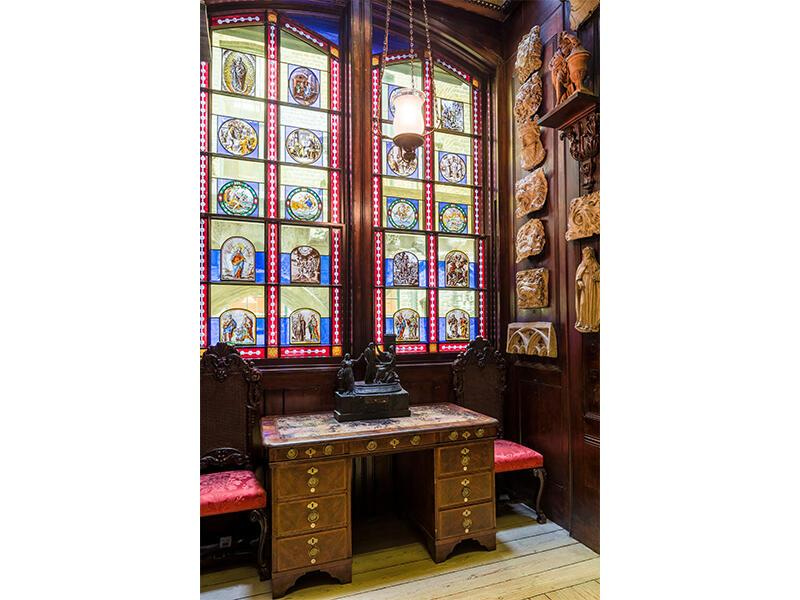
The desk in the window is walnut, heavy, early 18th century, and belonged to a prime minister. Around him on every surface were gargoyles, carved corbels, laughing stone faces and demonic ones, grotesques from Chester Cathedral. None of this should cohere. But it does. Every piece is exactly where it is. The arrangement is thought made three-dimensional, and anyone who describes it as clutter has not been paying attention.
What Soane was doing, in this room, was grief. But it was also something more precise than grief. He was reconstructing. He was saying: if I place these objects with sufficient care, if I learn the distance between the desk and the window, the relationship between the Flemish glass and the amber light, the exact position of each carved face on each wall, then something will stay. A room can be a form of memory. A room can be carried.
I have been writing about a girl called Maude Minor.
Maude’s house was taken from her, and so wherever she goes, she makes the rooms again by labeling empty places. Maude carries the floor plan of everything she lost, folding it smaller and smaller until it fits inside her wherever she needs to go. Everywhere she and her mother move, Maude unfolds the blueprint again, placing herself within it, oriented, located, home.
The world calls this OCD. What the world is noticing, but failing to understand, is the architecture.
Precision is the thing that holds. It is the reason Maude can stand in an unfamiliar room and know where the door would be, where the light would fall at this hour, which corner is the safe one. She counts things because she is a surveyor, and she has a map to maintain, and the map is all she has left of something irreplaceable.
In the Monk’s Parlour, Soane did the same thing. He lost his wife. He lost, with her, the particular dimensions of their life together. And so he built. He placed. He arranged until the arrangement held the weight of what was gone. “Dulce est desipere in loco,” he wrote, which is Latin for “it is delightful to play the fool occasionally,” which is also a man’s way of saying: I built a room for a monk who does not exist because the person who did exist is no longer here, and this is the only floor plan I have left.
He would have understood Maude. She would have known, immediately, upon descending the stairs, what kind of room this was.
The acoustics in the basement are different from the upper floors, muffled by stone and earth, the city traffic reduced to something distant and irrelevant.
You can feel when someone has stood in it at every hour of the day, in every season, knowing the relationship between this ceiling and this stone and the sound of the city above it, and has placed things accordingly.
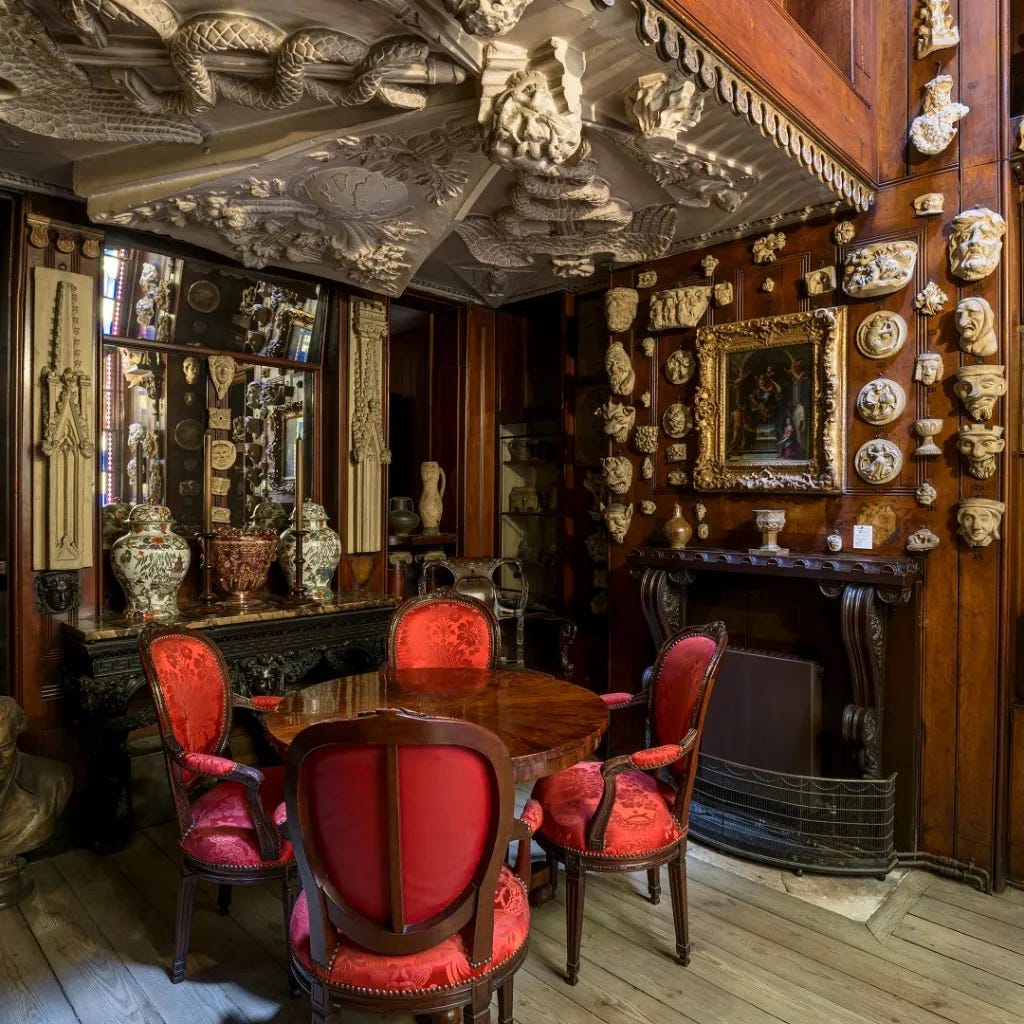
I stayed until they asked me, politely, to leave.
Outside, Lincoln’s Inn Fields was doing its usual business, barristers at pace, pigeons negotiating, the plane trees enormous and indifferent to all of it. I found a bench and poured myself a cup of tea from my thermos.
Soane built the Monk’s Parlour the year after his wife died. He was sixty-three years old. He had thirty-two more years to live, and he spent them refining the arrangement.
Maude Minor is eleven years old. She has thirty-two years and considerably more ahead of her. She is already, at eleven, the finest surveyor of interior space I have ever written. She knows which window faces east. She knows the distance between every piece of furniture in a room she has visited once, two years ago. She has the whole floor plan inside her, updated, cross-referenced, maintained.
The world keeps telling her this is too much.
The world has not seen the Monk’s Parlour.
Stirrings is where I write about the process of writing, the characters, and the experiences that shaped them. The Underestimated Club is a series of five books that each star a neurodivergent child. If you’ve found your way here, you may be one of those people. Or you may love one. Either way, welcome to the Underestimated Club.